Claude Code builds a first version of most of my ideas in one evening, and I can assure you, I have a LOT of ideas. But a working app doesn't tell me whether a customer actually wants it as well. Earlier this month I asked Claude to build one page first, one that actually tells me when to stop building.
TLDR: Write down what counts as a 'yes' from a customer. Then let AI keep the score and warn you when you want to build.
For new readers: with Mission Relearn, I help businesses with AI adoption, while putting the human central.
One offer, one test
I picked one offer to test: the Build Track. I automate one real work process for a company in 90 days, with the tools they already have, Copilot or Claude. My buyers are directors of companies with 10 to 100 people.
I test it with the PULL framework by Rob Snyder, which I heard on Lenny's Podcast. PULL stands for Project, Unavoidable, List of options and Limitations: which project is on the customer's list, why it has to happen now, what they already try, and where that falls short. Claude grilled me about the test, the way I described in last week's edition, and turned my answers into one page in my own dashboard.
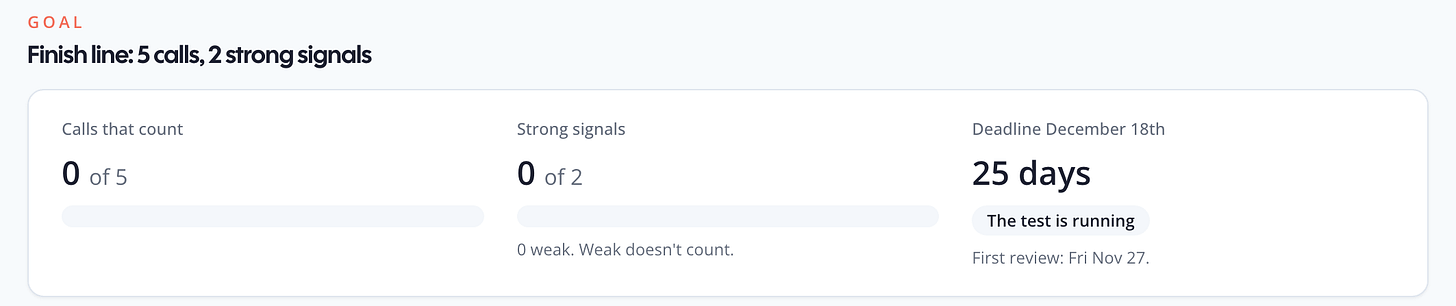
At the top of that page sits the finish line: 5 calls with directors before December 18th. With two strong signals or more, I go on with this offer; otherwise I write a new hypothesis.
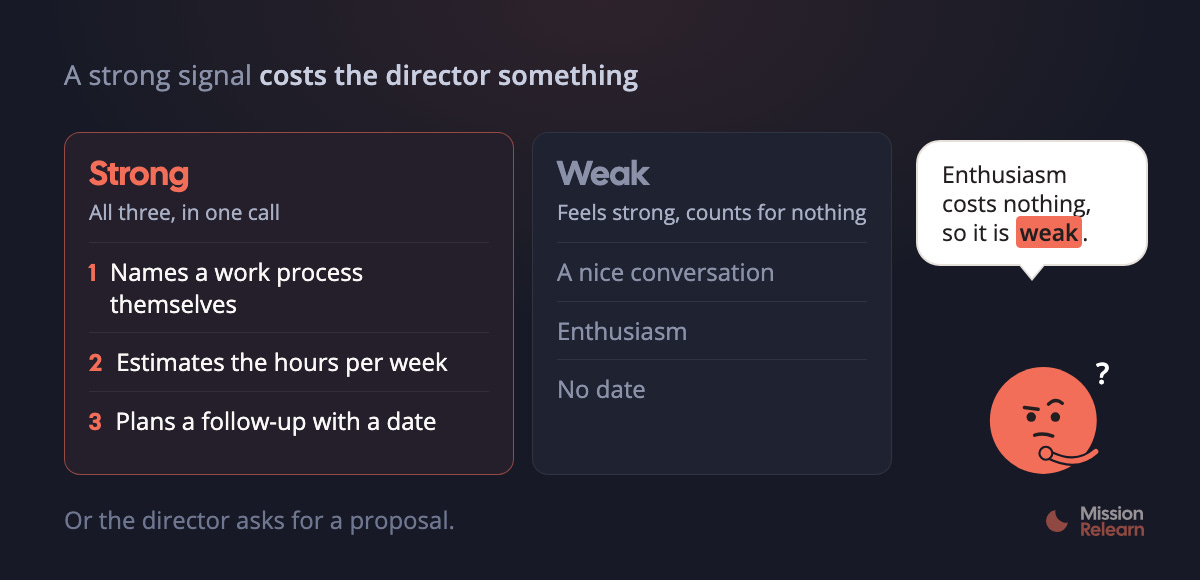
Writing down 'strong' took me the longest, because a nice conversation feels strong to me. So a strong signal needs three things that cost the director something. They name a work process themselves, they estimate how many hours per week it takes, and they plan a follow-up with a date (or ask for a proposal).
The build gate
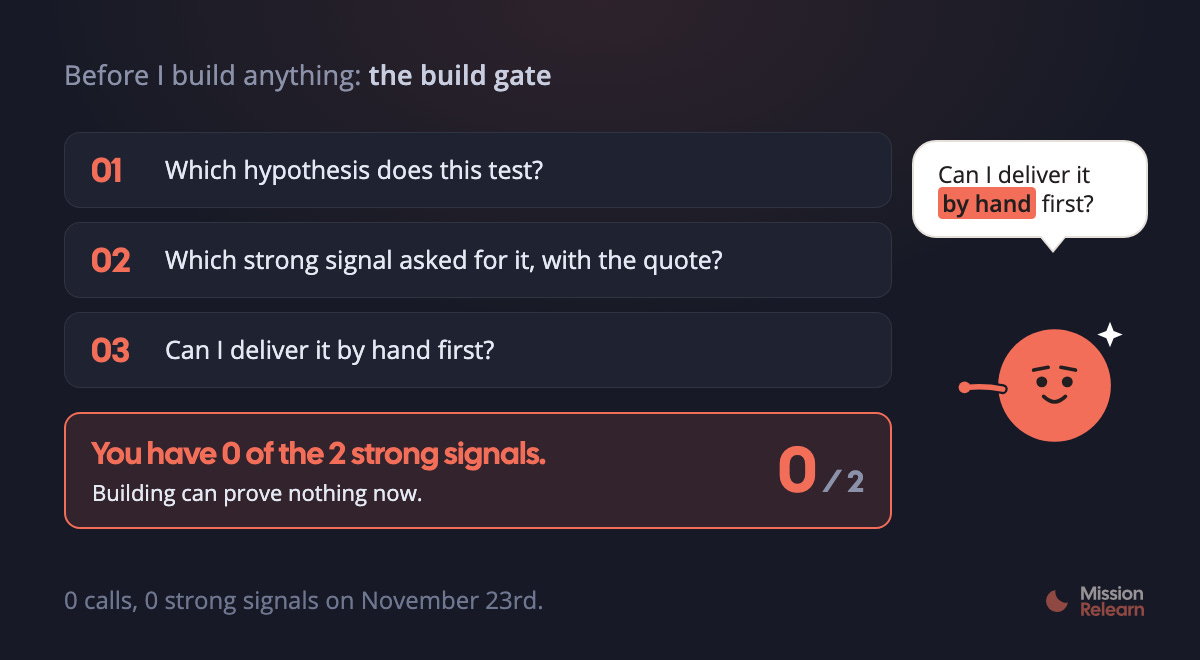
Before I build anything, the page asks three questions. Which hypothesis does this test? Which strong signal asked for it, with the quote? Can I deliver it by hand first? With fewer than two strong signals, it shows a coral warning. It will also show up on the day a call leaves me excited.
The recipe
Steps 1 to 3 work in any chat window. For steps 4 and 5 you need a tool that builds pages or artifacts, like Claude Code, Claude Cowork or Grok Bot.
1. Write your hypothesis in four lines. Give your idea in one sentence, then add: "Help me write a PULL hypothesis for this. Ask me one question at a time about the project on my customer's list, why it is unavoidable now, which options they already try, and where those fall short. Use my customer's words where you can."
2. Define 'strong' before your first call. Add: "Define a strong and a weak signal for this test. A strong signal costs the customer something: their time, a number, or a date in their agenda. Enthusiasm costs nothing, so it is weak."
3. Set a finish line with a date. Pick a number of calls, a number of strong signals, and what you do when you miss. Mine: 5 calls, 2 strong signals, December 18th.
4. Ask AI to build the scoreboard. Ask: "Build one page with the next step at the top, the finish line with progress bars, a list of calls with a signal (strong or weak) and the quote that proves it, a log of what customers ask for instead, and a Friday review with weekly counts." A spreadsheet with the same columns works too.
5. Add a build gate. Ask: "Add a form with three questions I answer before I build anything: which hypothesis does this test, which strong signal asked for it (with the quote), and can I deliver it by hand first? Show a warning when I have fewer than two strong signals."
What would your build gate stop first? Mine has a long list ;)
What I read this week:
37 customer problems in 2,500 book reviews: Douwe Wester scraped the reviews of the top 50 go-to-market books, and AI found 37 that describe what his clients struggle with.
Inputs before homepage copy: Douwe Wester rewrote his $5K homepage six times, then started over with his ICP and positioning first.
What to build when AI can build it all: Dr Philippa Hardman names four learning builds with the most impact, like decision simulations and fading worked examples, and tests Claude, ChatGPT and Gemini on the same documents.
Skills for designers and engineers: Emil Kowalski shares about 19 agent skills for interface work and animation, which you install with one command.
A strong model on your laptop: Niels Rogge on Inkling-2-Mini by Thinking Machines Lab, which runs locally with about 20 GB of memory.