Since Saturday, seven bots work on Memnar, and I only talk to one of them. Its name is Mem, my Chief of Staff. The other six, Madelief, Mira, Merel, Maya, Marit and Mona, report to Mem. I set it up in Grok Bot during a long car ride, and it took less than an hour.
The part I loved most, you ask? The fact that they consult each other before anything reached me. Mira does research, Madelief does learning design, and Mona, my CISO, fixed several security checks. Mem collected all of it and gave me one action list.
TLDR: Mem now runs six bots for me, and the comments under my LinkedIn post showed me what that convenience costs.
I posted about Mem on Monday. The comments were really insightful, so here are a couple of lessons.
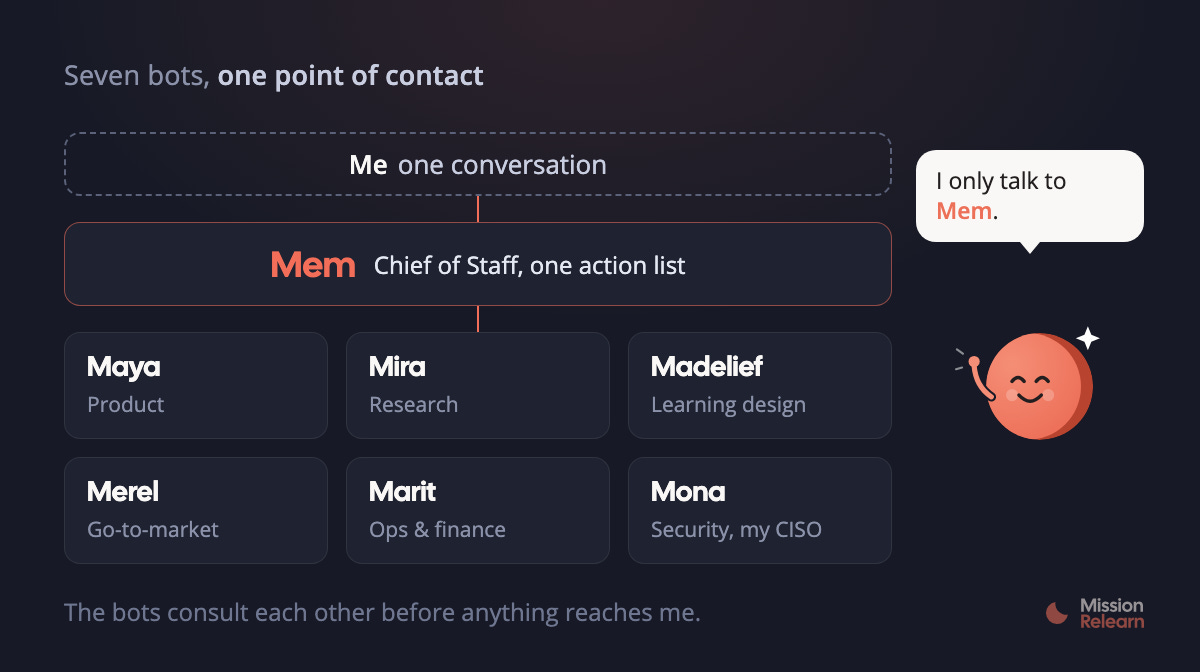
Lesson 1: one point of contact
My Mac Mini runs seven cron jobs that I call my 'agent swarm' (not real agents, I know). Compared now to the seven that run on Grok Bot, they feel a lot less useful.
Grok Bot drives the browser itself. It connected to Nextcloud, Proton and GitHub, and once I linked my repository and files, my Chief of Staff called Mem had an overview of what to do. I also loaded a podcast from YouTube, and Mem used that knowledge in this week's work.
What happens to the seven cron jobs? I'm honestly not sure yet. I'll definitely try to improve them or relieve them of their tasks if it doesn't work out.
Lesson 2: tell your agents how to write
I asked all seven bots to write in ASD-STE100, Simplified Technical English. It's a writing standard from aircraft maintenance: short sentences, active voice, one instruction per sentence, one meaning per word.
I noticed it right away: overview and FOCUS! The bots made one action list, and that saves me from endless messages.
Lesson 3: convenience or ownership
Roel Schenk, an agentic AI architect, asked under my post whether I had tried Hermes with different profiles. That way, I would control my own stack and could use any model provider. I had tried it, and I found it hard to set up. Grok Bot was so easy that it would be hard to match the convenience.
Roel prefers to own his stack, so he can tweak it the way he wants. He runs a Qwen model on his own hardware at around 60 tokens per second. When he needs the big commercial models, he sends the work through a filter that finds secrets and personal data and removes them first. Tom Jongens added OpenHuman as an option.
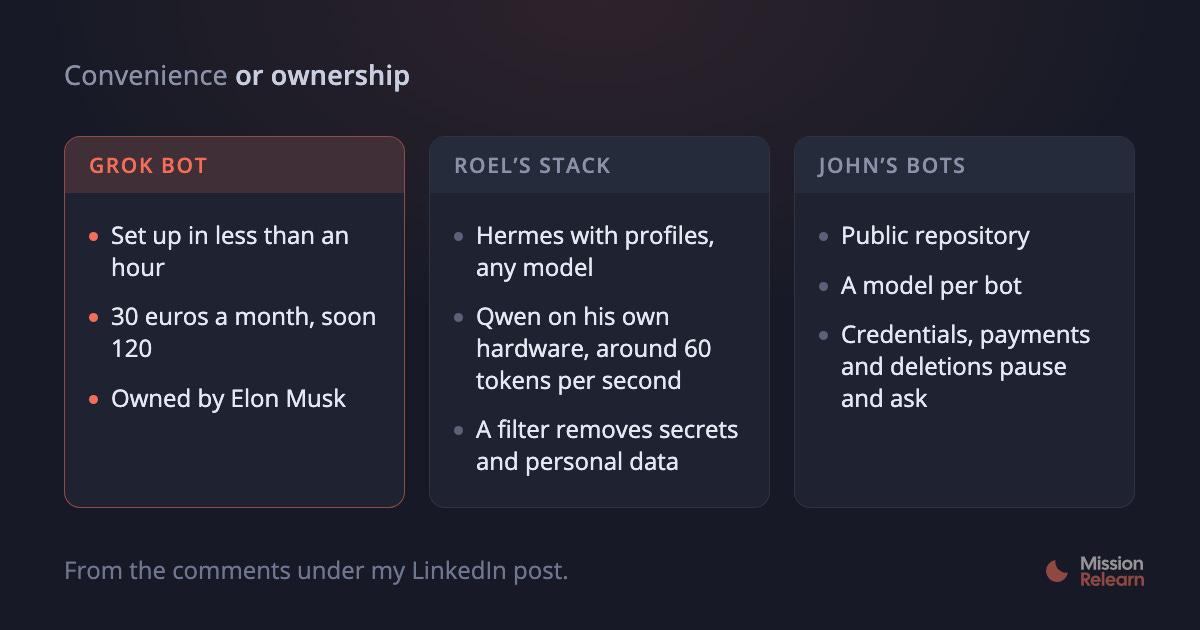
John Lewis built his own version and put it in a public repository: Bots. You pick a model per bot, the bots hand work to each other, and credentials, payments and deletions always pause and ask you.
I think Roel is right, and I want to own my own stack. First thing after this newsletter is that I'm Reverse Engineering Grok Bot and see what features there are to put into place, similar to John Lewis his way of working.
Lesson 4: the vendor is part of the choice
Grok Bot belongs to Elon Musk, and I find him unreliable and controversial. I still gave his product access to my files, email and code.
It was mostly to experiment and see what the future of agentic working would look like, so I'm hoping to move to my own stack this month or when Claude Duet is coming out.
So my picture for now: I talk to one agent, that agent runs the rest, and I still have to decide how much of the stack I own and who gets access. One other commenter was right: let's see how this world looks 6 weeks from now (the pace is insane).
The recipe
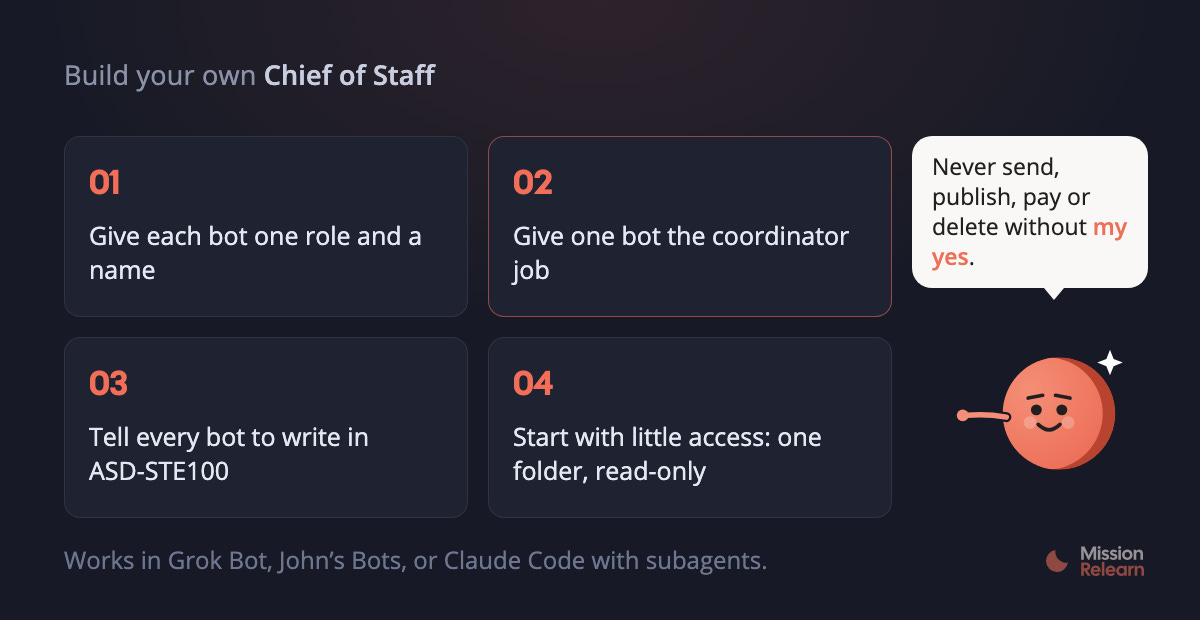
This works in any tool where bots can hand work to each other: Grok Bot, John's Bots, or Claude Code with subagents.
1. Give each bot one role and a name. Mine are research, learning design and security, among others. A name makes it easy to tell who said what.
2. Give one bot the coordinator job. Paste this as its instruction: "You are my Chief of Staff. The other bots report to you, and you are the only one who talks to me. Before you report, ask the bots that know more about the topic. Once a day, give me one action list: what is done, what needs my decision, and what can wait. Never send, publish, pay or delete anything without my yes."
3. Tell every bot how to write. This is the rule I use: "Write in ASD-STE100 (Simplified Technical English): short sentences, max 20 words for instructions and 25 for descriptions, active voice, simple tenses, one instruction per sentence, one meaning per word."
4. Start with little access. One folder and one repository, read-only, and no passwords in the chat. Add more once you trust the action list.
Which name would you give your Chief of Staff? All seven of mine start with an M and are female on purpose ;)
What I read this week:
Security called me at 6:12 AM: an IT admin patches PHP servers that nobody owns and nobody dares to turn off, including one with 4,512 days of uptime.
Every Mac on macOS 27 now has a free LLM in the Terminal: Alvaro Cintas on a local model with no account, no API key and no token bill, limited to 4,096 tokens per session.
How I use AI in the design phase: Philippa Hardman shares three prompts for learning design, each with a check to run on the output.
Peter Thiel's blunt test for startup teams: Guillermo Flor on why founders who call their results luck have skipped the analysis.
This is how you should actually make launch videos: Farza Majeed with Y Combinator on treating every demo as a launch, and why 20,000 YouTube views can beat 3 million on Twitter.