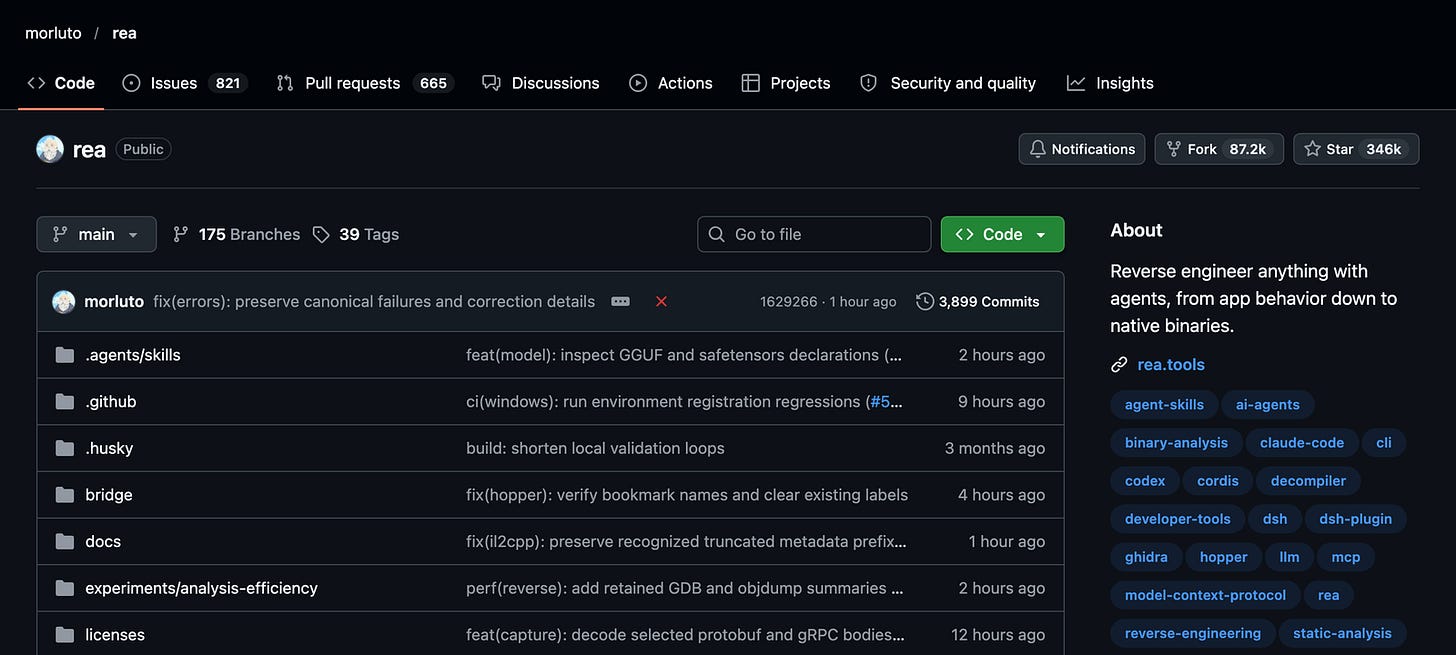
On October 13th, I installed 'Reverse Engineer Anything' (REA) and asked Claude Code to use it to replace every subscription I could do without. REA is a free GitHub repository with over 300,000 stars this morning.
TLDR: Claude turned down two of my requests, and one tool now runs in my own dashboard.
REA reached 809 points on Hacker News on October 10th. You point an AI at an app, it shows you how a feature works, and then it builds you a similar version.
While scrolling on LinkedIn, I saw many posts claiming either software is dead, or a startup's moat is gone, because anyone can rebuild the product (except for deep tech and similar).
Let's try it out then.
REA went through the tools I use to run Mission Relearn and Memnar. It could read 16 apps on my Mac straight away, the ones built with Electron (a way to ship a web app as a desktop app). For tools where the value sits in the cloud or in the content, like video calls or design files, it didn't help at all.
Completing two of my requests would have meant getting around a licence: using Word, Excel and PowerPoint without paying for them, and lifting the word limit on my dictation app.
The tool I did replace was my CRM. Claude Code rebuilt the parts I use in my own dashboard: people, companies, lists with their own fields, notes, and a table, board and detail view. It didn't open a single line of the vendor's code, which was impressive.
So for clarity, what the law allows
After letting Claude explain this to me in normal people's language, I've learned the following:
In the EU, copyright protects the code of a program and leaves the ideas and functions behind it free to use (Software Directive 2009/24, article 1). If you have the right to use a program, you may observe, study, and test it to understand how it works, and any contract that forbids this is void (articles 5 and 8). The EU Court of Justice confirmed this in 2012, in SAS Institute v World Programming.
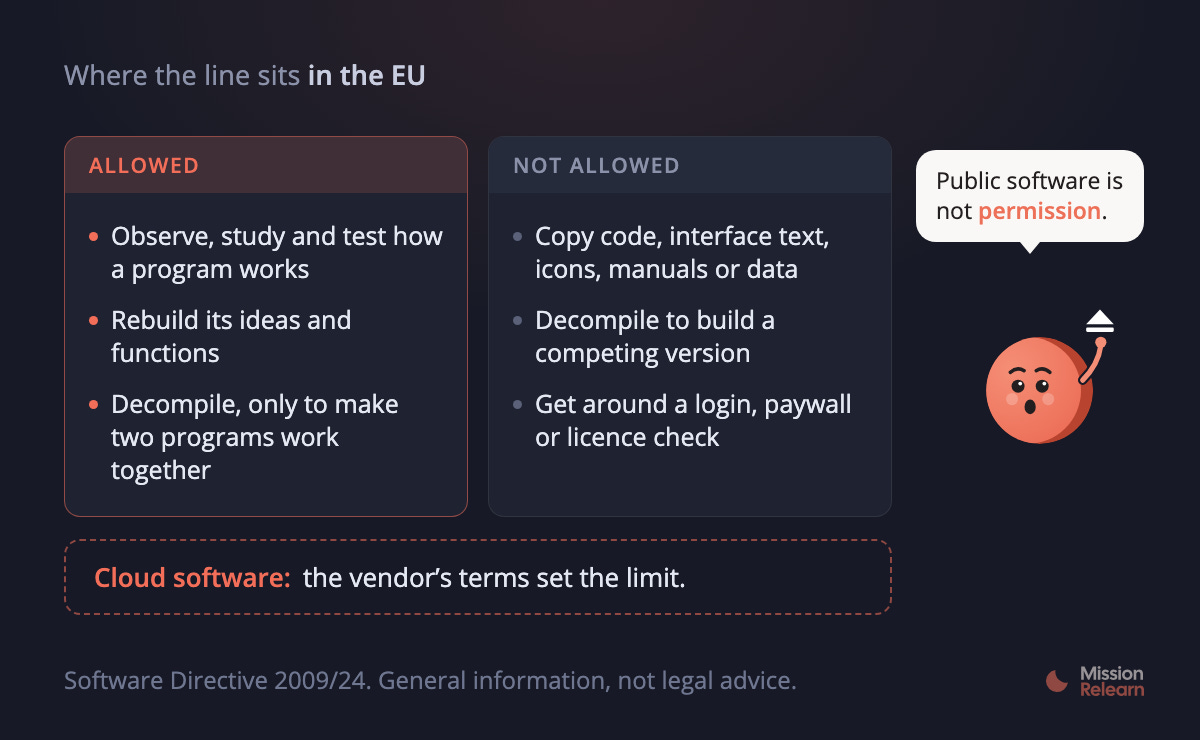
Decompiling, turning a program back into readable code, has stricter rules: you may only do that to make two programs work together, never to build a competing version. The law also forbids copying code, interface text, icons, manuals or data, and getting around a login, a paywall or a licence check.
For software that runs in the cloud, the law is less clear, because you never get a copy of the program. There, the vendor's terms set the limit. HubSpot's customer terms, for example, forbid reverse engineering the "underlying structure, ideas, know-how or algorithms" of the service. Many vendors also forbid using their service to build a competing product.
So. I rebuilt my CRM for my own use. Taking a product apart to sell a cheaper copy rides on the work of the people who built it, and I wouldn't do that. REA's own disclaimer says it too: "Public availability of software ... does not by itself establish permission."
Who is right?
Some people say every SaaS tool can now be rebuilt; others say the law will stop that. Investors and CEOs don't agree either.
On February 3rd, Anthropic launched a 'Legal' plug-in for Claude, and the shares of Thomson Reuters, RELX and Wolters Kluwer fell 16, 14 and 13 percent that day.
At Dreamforce in September, Salesforce CEO Marc Benioff said he had been hearing "crazy nonsense about the SaaSpocalypse". In a Retool survey of 817 of its own customers, 35% had replaced at least one SaaS tool with something they built themselves.
My own test came out smaller: out of my whole stack, Claude Code rebuilt one tool, the CRM.
The recipe
Pick one tool you pay for, like your CRM. Work in your own account, the way any user would, and use a test workspace with made-up contacts instead of your customers' data.
Open Claude in Chrome (the browser extension) on that tool and ask: "Go through every screen of this tool the way a user would. Only look at the interface: don't open the developer tools, don't read the network traffic, and don't copy any text, icons or data. List every feature with one line on what it does. Then ask me, feature by feature, how often I use it: every week, sometimes, or never. End with the features I would need to rebuild for my own work, and the ones I can drop."
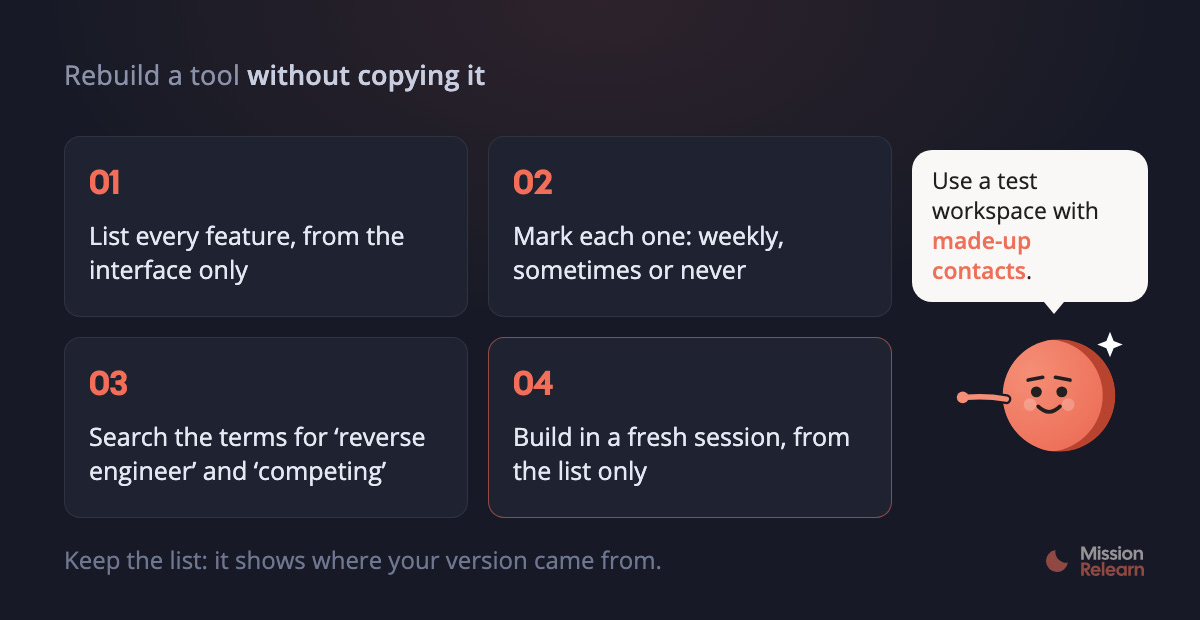
Before you build anything, let AI search the vendor's terms for 'reverse engineer' and 'competing', and read what it finds yourself. Then start a fresh session, give it only the feature list, and let AI build the features you marked. That session never sees the vendor's code. Keep the feature list, so you can always show where your version came from.
This is general information about EU law, not legal advice. Do you want to sell what you have built? Talk to a lawyer first.
Which tool would you rebuild first? Mine was the CRM, and I'm still paying for a password manager ;)
What I read this week:
How to tell if a startup has a moat: Dan Hockenmaier's guest post on Lenny's Newsletter, with four moats that still hold: switching costs, network effects, economies of scale and data.
Scrambling to chase any remaining moats: Pieter Levels lists the moats he has left, names regulation as one of them and then skips it.
REA on GitHub: the repository itself, and its disclaimer is worth reading before you install it.
The Last Moat: a US lawyer at Whiteford argues that a patent may be the only barrier left when AI can clone your software in an afternoon.