
I lived every part of the story I told at an AI030 meetup in Utrecht on October 1st, and the first deck AI made for it didn't feel like mine at all. The talk was about how I started Memnar and what it taught me. Luckily, I checked rigorously before I stood in front of the room.
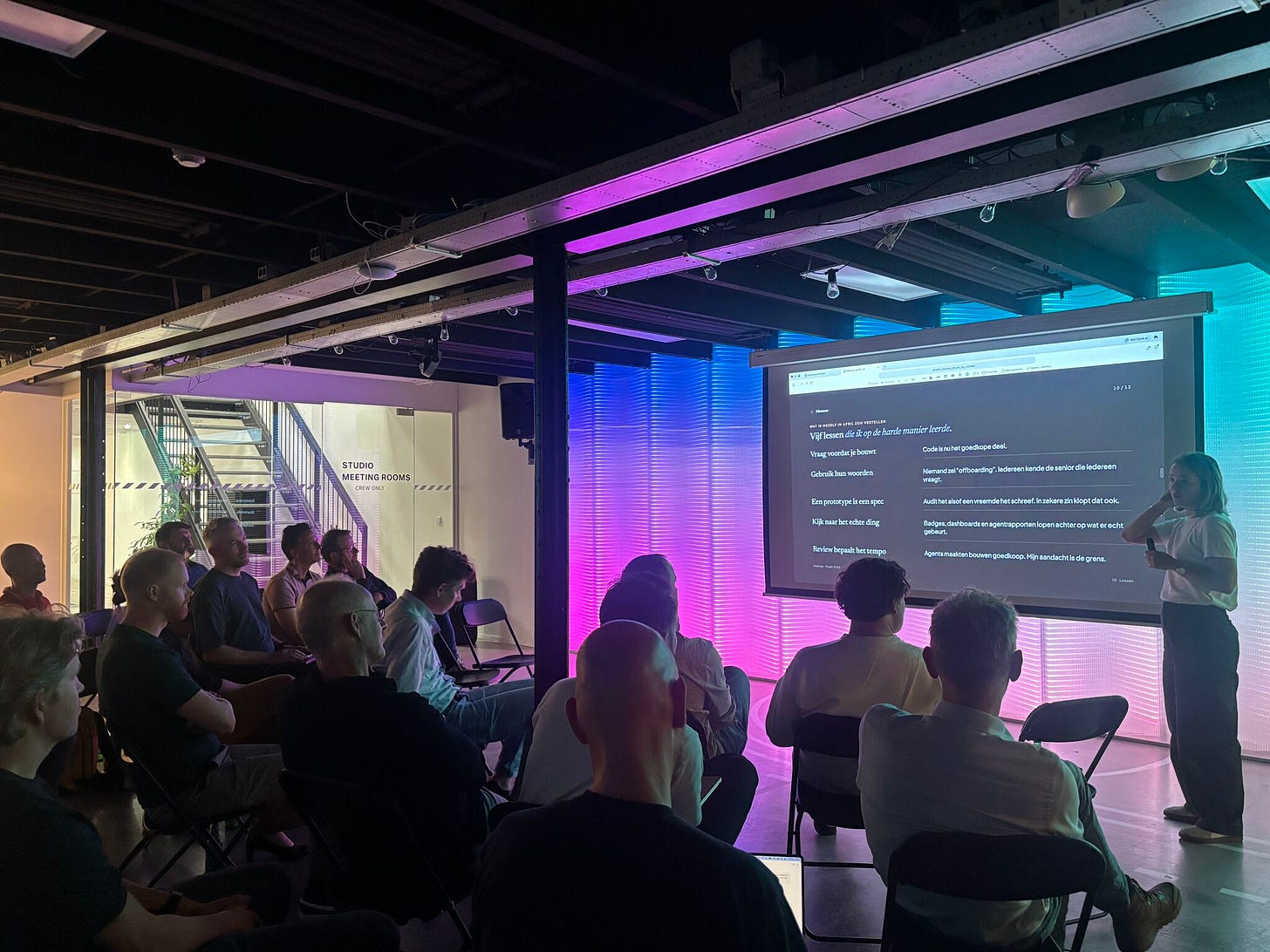
I do this a lot: grab a task without any direction and just start to get a first version. Then I find out that what came out isn't mine, and I end up polishing slide after slide.
On Lenny's Podcast, Lenny Rachitsky talks with Molly Graham, who worked at Google, Facebook and Quip and now runs Glue Club, a development program for startup leaders. They talk about the human sandwich, a three-slice model for working with AI. A person sets the vision at the top, AI does the work in the middle, and a person reviews and improves it at the bottom.
The first deck AI 'pooped out' only had the middle slice.
I went back up to the top slice and decided what I wanted: the direction, who would be in the room, and my definition of good. I changed the message. The room was full of people who love vibe coding, so I built the talk around the human side of it: what happened when I took the vibe-coded product to the World of Technology & Science fair (WoTS) and talked to people who might buy it. There, I learned that buyers avoid the word 'offboarding' and talk about taking pressure off their senior people. The business pitch and the cringe "I learned to vibe code, and suddenly I was great at it" story were no longer part of the slide deck.
With the top slice in place, the middle was easy to hand off. AI went through six to eight versions of the deck. It researched who was coming and built the slides in code, with variants for me to compare.
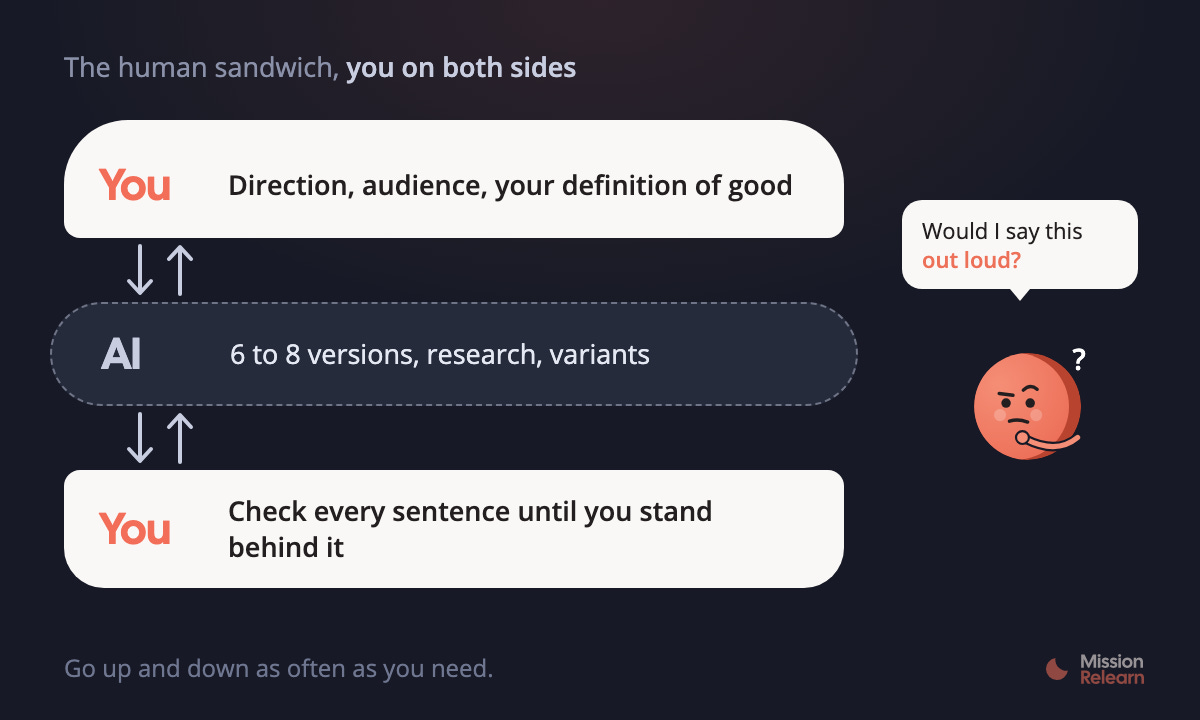
Then the bottom slice. I went through every slide and rewrote or cut each sentence I couldn't picture myself saying out loud to that room. If even one sentence doesn't feel like something I would say, my audience takes me less seriously.
The company Clay wrote one rule for its whole company into its AI writing policy: "You must stand behind every idea and every sentence in your docs." Graham puts it as 'you own it, however you made it'.
I move up and down between three slices, in any order, as long as all three are there in the end. Sometimes I have to find out what I think, and I don't know what my thoughts are beforehand. For this talk, I saw in the first deck what I wanted to say, and that I needed to go back to the top slice of the sandwich.
It made me think of how teams would go about this, and that is where the sandwich gets harder. In a team, the top slice belongs to several people, and they have to agree on the direction, the audience and what good looks like. Graham refers to Tuckman's stages of group development (forming, storming, norming, performing) and says a team can slip from performing back into storming.
Susan Wheelan, who researched how work groups develop, was required reading at my Hyper Island education. She calls storming 'counterdependency and fight': the stage where members push back against the leader and against each other. Her first stage, 'dependency and inclusion', is close to Tuckman's forming: people wait for the leader to set the direction and check whether they belong.
I see teams slip back into storming, and sometimes all the way back to forming in my own projects at Mission Relearn, with freelancers and with fellow project collaborators. AI doesn't change that. A storming team can have AI make ten versions of a deck and still fight about which one should be picked.
So when a team works with AI, it helps to know what stage it is in. A team that agrees on the top slice gets a lot out of the middle. A team that is still storming first has to answer the question from the title together: is this still our story?
The recipe
Run this check right before you share anything AI helped you make, like a deck, a post or a proposal.
First, write three lines yourself. Who will read or hear this? What is the one message you chose? What does good look like for you this time? This is your top slice, and if you can't fill it in yet, make a first version and come back to it.
Then ask four questions of every slide or paragraph:
Would I say this out loud to these people?
Did this happen to me, or did AI add it along the way?
Does it carry the message I chose?
Does it meet my definition of good?
AI can do the first read for you. Paste your three lines and your draft, and ask: "Go through this slide by slide or paragraph by paragraph. For each one, quote the sentence that sounds least like me or does least for my message, and say why in one line. Don't change anything." Then you decide per sentence: keep it, rewrite it in your own words, or cut it.
Paste the four questions and the prompt once into your assistant's standing instructions, so the next draft only needs your three lines.
In a Claude Project: open the project > Set project instructions.
In a custom GPT: Edit GPT > Configure > Instructions.
Which slice do you skip? Mine is the top one: I'd rather just start ;)
What I read this week:
Plan with Opus, build with Sonnet, review with Fable: Alvaro Cintas splits one job across three models, with Opus 5.5 planning, Sonnet 5.5 executing and Fable 5.1 reviewing in the background.
AI Certified: a site where you get AI certifications without doing anything, because ChatGPT takes the courses and the tests for you.
The first hundred users: Brent Chudoba on how you get from zero to a hundred users, and how hard that is.
Awesome Opus 5.5 videos: this repo is 🔥, with the 853 prompts behind a collection of Opus 5.5 videos, and 523 of them have a remake on Skillry.