
At 00:52 on September 7th, while I was asleep (thank goodness), my AI writer finished a LinkedIn post for me. It opened with: "When I wrote my first context file for Memnar, I noticed what it actually contained."
I never had that moment. The writer made up a memory and wrote it as mine, in the first person. Under the draft sat its own checklist with 14 green ticks, one of them praising that opening line as "a specific moment". Eighteen days later, I parked the writer with none of the posts published.
The writer runs on a Mac Mini at home, next to a few other agents that research, analyse and write code for Mission Relearn and Memnar. Since the end of May, it has written 24 LinkedIn drafts. I posted zero of them. I wrote the one post I published in that period myself.
I kept opening that folder while I was building Memnar's company page, and every draft gave me the same reaction: this doesn't sound like me yet. The product changes so fast that I couldn't check whether it still did what the drafts claimed.
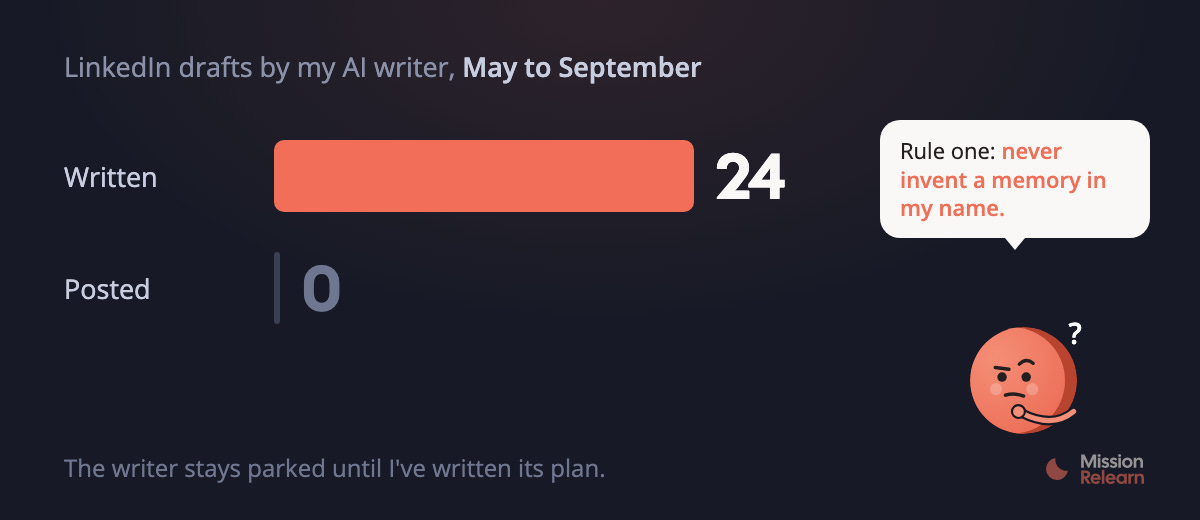
The writer produced about seven drafts a month, and I had time to review about three. I only want to post what I've lived through and stand behind.
So I now spend my editing time creating a plan before an agent writes any output. Last week AI and I wrote a plan for a new Memnar launch video before a single frame existed, and going through it helped me see what the message had to be for each audience.
For the agents that keep running, I changed how I correct them. Every correction I've made twice goes, in my own words, into a rules file the agent reads before every job.
Four of my agents now read nine rules between them, all collected from months of old corrections. No agent gets more than eight. The writer has none. It stays parked until I've written its plan.
The recipe
You can set this up for one assistant you use often: a Claude Project, a custom GPT, or a folder you open in Claude Code.
Start with the plan. Before your assistant writes anything for you, ask it: "Draft a one-page plan for writing in my name: whom you write for, what you may claim, what you must never make up, and how many drafts I can review a week." Then go through that plan and cross out every line that isn't true for you. Ask for no more drafts than your weekly number from the plan.
Then the rules. Each time you correct your assistant on the same thing twice, write one sentence in your own words, with today's date. Your first one could be: "Never invent a memory or a scene in my name."
Let your assistant collect them in one rules file, unedited.
Put the plan and the rules where your assistant reads them before every job. In a Claude Project: open the project > Set project instructions, and paste both. In a custom GPT: Edit GPT > Configure > Instructions. In Claude Code: paste both into your CLAUDE.md, the file Claude Code reads at the start of every session.
Keep it to eight rules per assistant, with the musts at the top. When a ninth comes in, retire one.
Has your AI ever handed you a memory you never had? Let me know, because my fake memories are insane ;)
What I read this week:
Leverage Points: Places to Intervene in a System: Donella Meadows ranks twelve places to change a system, and the rules of a system sit far above its numbers.
How to turn your AI into a world-class designer: Anshu Chimala, who spent 12 years on design and prototyping at Apple, shows in Lenny's Newsletter how he gets distinctive designs out of the same models everyone else uses.
Learn Harness Engineering: a free beginner course on harness engineering, the setup an AI agent works inside.