I only start building a company brain once the company names the two people who keep it up to date.
On the 2nd of October, I showed my slides at an Expert Table, a group of people who build company brains. My setup puts a company's brain in plain text files that the team and Claude both read.
TLDR: Without two named owners, nobody removes what is out of date, and the brain goes stale.
For new readers: I build company brains for teams with Mission Relearn, your own context, voice and rules in files you own when working with AI.
Who is the brain owner?
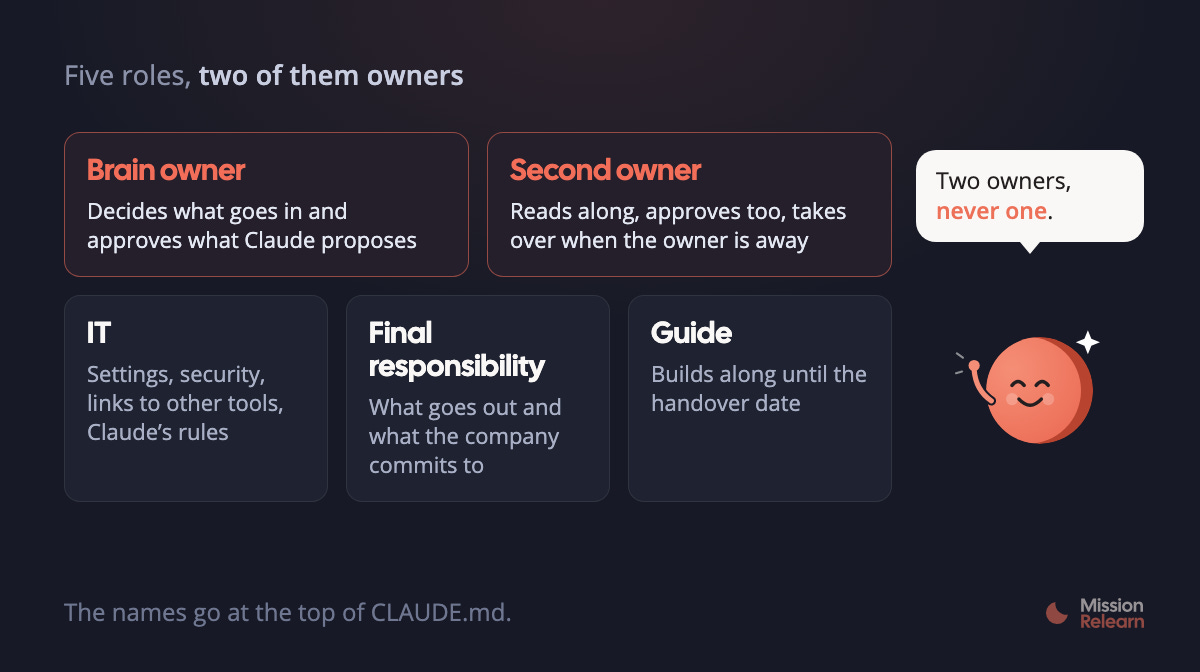
The intake form for every new company brain asks for the names of the brain owners first. The brain owner I look for usually leads a project or is about to step into a management role, and enjoys working with new technology. That person decides what goes into the brain. Claude proposes a change, the brain owner approves it, and GitHub stops Claude from adding anything by itself.
At the Expert Table, I warned that one brain owner carries far too much weight for the organisation. One person gets ill, goes on holiday or leaves, and the brain stops being productive or up-to-date.
So, every brain gets two. The second owner reads along, approves changes too and takes over when the brain owner is away. Around them sit three more roles. IT looks after settings, security, links to other tools and Claude's rules. One person carries final responsibility for what goes out and what the company commits to. And I build along as the guide until the handover date arrives.
The market agrees on one thing
For my own knowledge base, I mapped the 'company brain' market. One source was Slite's 2026 e-book. Slite sells a company brain itself and describes ten setups, from mem0, Letta and Zep to a DIY setup with Claude Code and git. In its survey, only 17% of teams have a brain that really runs, and about half of those built their own on Claude or Codex. Slite has an interest in that story, so read the numbers with that in mind.
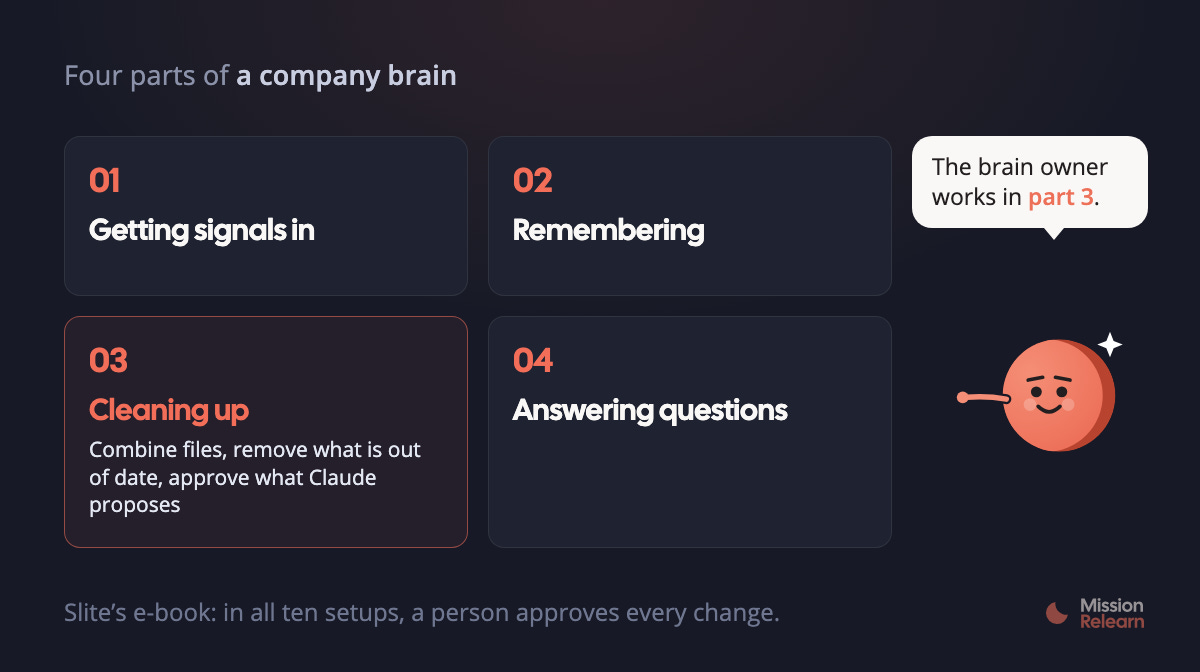
In all ten setups, as in mine, a person approves every change before it goes into the brain.
That's why I sort every company brain template into four parts: getting signals in, remembering, cleaning up, and answering questions. The brain owner's job sits in the third part: combining files, removing what is out of date, and approving what Claude proposes.
The brain shows the organisation
At two companies, the brain showed how the organisation works. At the first one, four out of five questions that went to 'community' actually belonged to operations. The team saw this during the development of their company brain and reviewed its roles.
The second company said the tone of the emails from the CRM didn't fit. The tone actually came from one employee who answered most of the tickets. That started a conversation in the team about how they want to sound.
How long it takes
The brain owners I train are often not technical, and they have to get comfortable in programs such as Claude Code, Visual Studio Code and GitHub. They usually feel pretty much at home after session 2 or 3.
GitHub is hard for most non-technical people, and the Academy they get a login to names that as a known limit. So the agreement is that the brain owners work in it, and the rest of the company reads along in Cowork or a Claude Project.
The recipe
You can try it on your own process, data and colleagues with Claude Code, a GitHub repository and the kit I use.
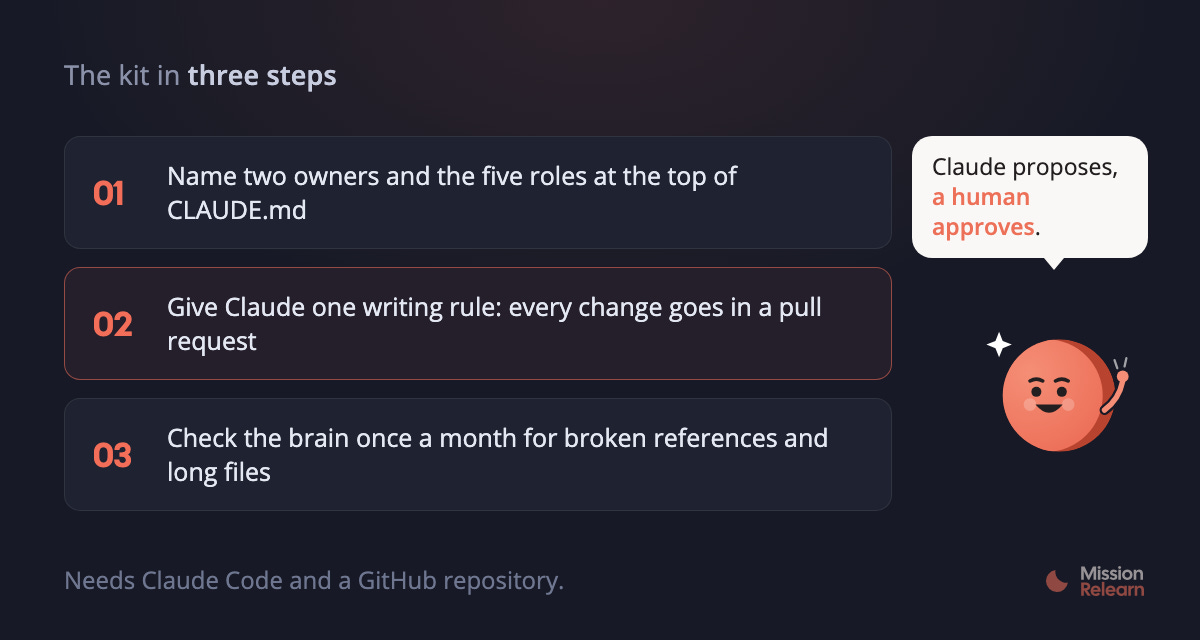
1. Name two owners and the five roles. Write the names at the top of your CLAUDE.md, the file Claude reads first: brain owner, second owner, IT, final responsibility and guide. One person never holds both owner roles.
2. Give Claude one writing rule. Paste this in the same file: "You never change the knowledge files directly. Put every change in a pull request and explain in one sentence why. Only the brain owner or the second owner approves."
3. Check the brain once a month. Ask Claude to look for broken references, duplicate versions and files that grow too long.
If you want a starting point, the Company Brain self-study in my Academy gives you the starter folder with the intake form, the five roles, the rules for Claude and seven lessons. You work through it on your own, with Claude.
Who should be the two brain owners in your company? Reply to this email and tell me.
What I read this week:
The Newsletter Is Dead. Here's How To Survive AI Agents: The Nathan Barry Show on what happens to newsletters when agents do the reading.
New research on metacognitive onloading: Philippa Hardman on new research by Fan et al. that introduces 'metacognitive onloading'.
Spotify cut their Claude Code token bill by 90%: Aakash Gupta on how they did it and open-sourced it, because agents spend most of the bill on reading.
All my Grok Bot tutorials in one place: Peter Yang collected his guides for the bot I used for my Chief of Staff last week.
The End of Software Engineering: Rubén Domínguez Ibar on an arXiv paper by Zhenfeng Cao, where judgment becomes the actual JOB.