
As you read this, I’m on day two of WebSummit in Lisbon. The main event is cancelled because of Storm Charles but this gives me more time to share some insights.
My preparation started in July, with a speaker application that didn’t get accepted. Last Thursday morning, I rewrote my visibility plan three times.
TLDR: Pick one goal for the visit first. Then let AI check every profile, message and invitation against that goal.
For new readers: with Mission Relearn, I help teams work with AI, using their own knowledge and rules in files they own.
What I built
For this trip, Claude and I built a prep folder in October, a prep page with an offline demo and a QR code (now on version 11), a profile in the Web Summit app and a script to log new contacts in my CRM.
My own verdict last week: overprepared, understructured.
I changed course too. People I trust told me not to lock everything down.
One goal, even if it's walking around
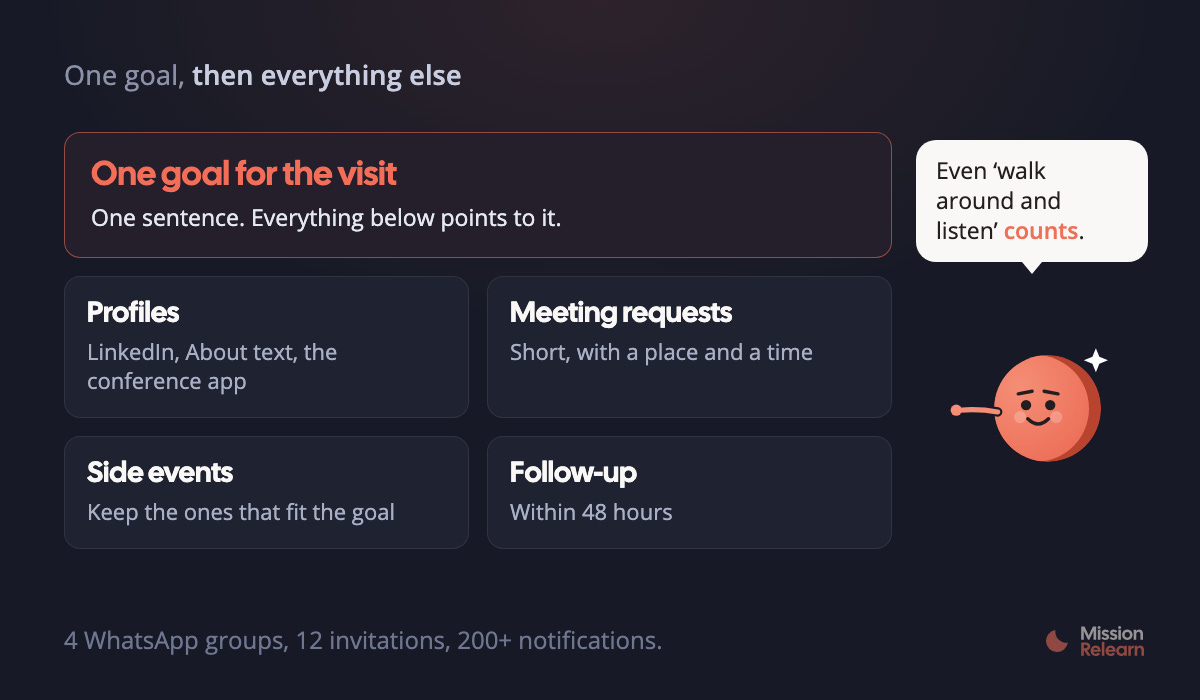
The best tip I got came from Yana Basaranovich: know your goal for the visit, even if that goal is to walk around and listen. Then line up your social profiles, your documents and your material with that goal.
Yana is a communications advisor who prepares founders for Web Summit and Slush. My three rewrites last Thursday came from her playbook, and her deck opens with "Most founders prepare the pitch. Few prepare the visibility." Her plan starts three weeks before the event and runs until after it.
On November 3rd, I sent 8 connection requests in the app. By Friday, I had 30 connections.
Side events live in WhatsApp
Around Web Summit, organisers share the side events in WhatsApp groups first. I'm in 4 of them, I have 12 side-event invitations, and one of those groups exists for a single startup dinner. My phone is at 200+ notifications, and I use my goal to decide which invitations to skip.
The recipe
You can use this for any conference, with Claude, ChatGPT or Le Chat. Yana advises starting three weeks ahead, so start now if your next event is in December.
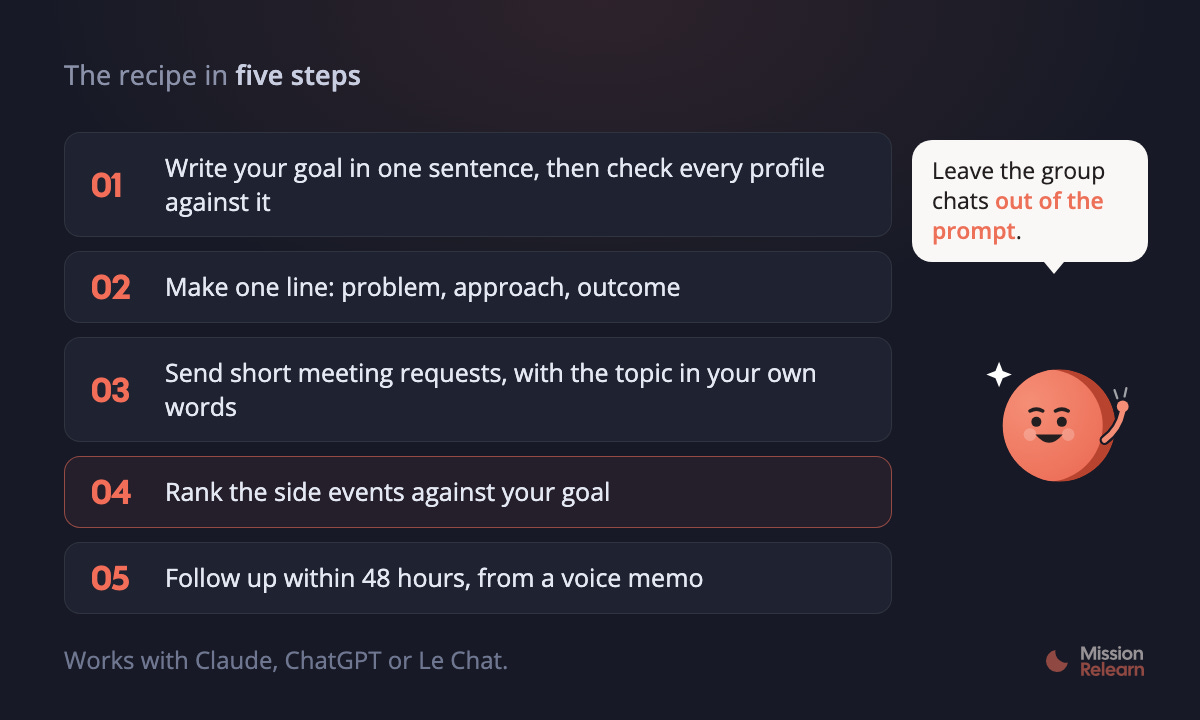
1. Write your goal in one sentence. Start a new chat and paste the goal, your LinkedIn headline, your About text and your bio from the conference app. Then ask: "Here is my goal for [conference] and my profiles. Check each profile against the goal. Show me every line that points somewhere else, and suggest a rewrite."
2. Make one line you use everywhere. Yana's formula is problem, approach, outcome. Ask: "Write five versions of a one-liner for me: the problem I solve, how I solve it, and the outcome. Max 20 words each." Pick one and put it on every profile in the same words.
3. Send short meeting requests. Yana's template: "Hi [Name], I'm [your name], founder of [company]. We [what you do in one line]. It fits your work on [topic]. Could we meet for 15 minutes at [place, time]?" Write the topic part yourself, from what that person publishes. Let AI tighten the rest.
4. Sort the side events against your goal. Paste the event details (title, date, host, description), and leave the group chats out: they hold other people's names and phone numbers. Ask: "Rank these events against my goal and flag the ones that clash."
5. Follow up within 48 hours. Record a voice memo after each conversation. Ask AI to draft a personal follow-up from your notes, then edit it yourself before you send it.
How do you keep up with the WhatsApp groups at a conference, or in any busy group chat? Let me know, because I'm still behind on mine (haha).
What I read this week:
Find your AI level: The team at Every wrote one prompt that places you on their eight levels of AI adoption and names the next habit to practise. Paste it into Claude or ChatGPT.
Coding Wrapped: Turns your local Claude Code and Codex history into a private pixel-art story about how you work with AI.
ASD-STE100 Simplified Technical English: A writing standard from aircraft maintenance manuals: one instruction per sentence, max 20 words, one meaning per word. I put it in my own rules file, so my AI tool answers me in short, clear sentences.
How to build AI agents from scratch: Alvaro Cintas splits agent-building into seven steps.
Ideas are everywhere: Greg Isenberg talks to his agents more than to his team of 50+, and uses Grok Bot.