This week I gave my product a new name. MindFile is now ‘Memnar’, your portable, growing memory for AI.
To explain to new folks reading this: I run a one-woman AI consultancy Mission Relearn in the Netherlands and I build a product, Memnar, in public. So you get to watch me rename the thing while it's live, which is exactly as nerve-wracking as it sounds (working on it).
Behind the build: how you rename a product without breaking it
The old name was never really a good one. ‘MindFile’ is a real word other people use, and I want a name I can own, protect, and point a trademark at. So I went looking for a coined name with an available .ai domain, and landed on Memnar.
Before I committed, I ran a three-layer check:
a web collision audit (is anyone else using this),
an authoritative whois on the domains (the casual DNS lookups lie for .ai),
and a trademark search across the relevant classes.
All clear. On June 23rd I bought memnar.ai, memnar.io, and memnar.eu.
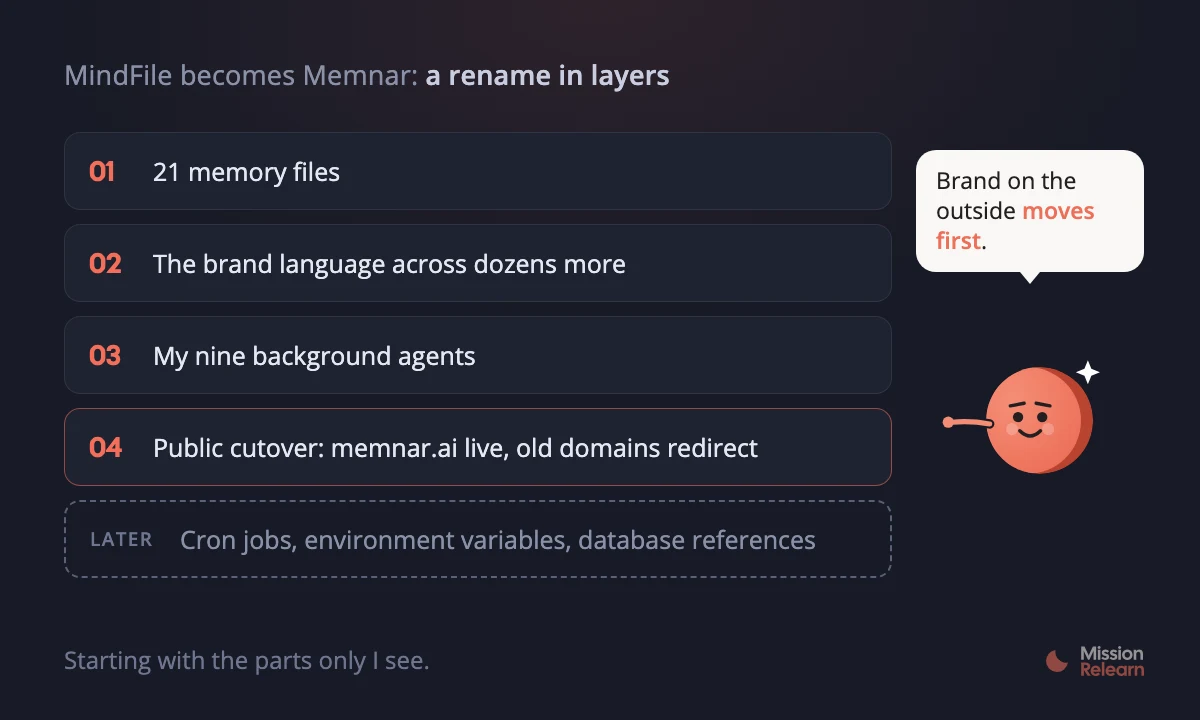
Then the actual work, which is a migration, not a find-and-replace. I renamed it in layers, starting with the parts only I see. About 21 of my memory files, the brand language across dozens more, my nine background agents, then the public cutover; memnar.ai is now live, and the old domains redirect to it.
I left the invisible plumbing on the old name for now. The cron jobs, the environment variables, the database references all still say ‘mindfile’ under the hood, because renaming those at the same time would be CHAOS. Brand on the outside moves first. The wiring moves later, in its own careful pass.
Building it safer before more people trust it
Here's a realisation that becomes more real every week; Memnar holds your memory for your AI, in your own words, hosted in the EU, owned by you. The moment I ask more people to put their real memory into it, the bar for how I build goes up. So I'm slowing the growth push and hardening the machine first.
A few things I put in place. Every push from my machine runs through a gate that scans for secrets before the code leaves the laptop, and it fails closed, so a leaked key blocks the push instead of travelling to GitHub. Every production change runs past an review pass before it merges. Last week that pass caught three real bugs my tests could not see, including one that would have overwritten an entire settings file.
Currently access is invite-only, with a server-side whitelist that fails closed. You're on the list or you're out, decided on the backend, not hidden in the frontend where anyone can poke at it.
My favorite proof: I had a writer agent report ‘0 em-dashes’ on a draft that had nine. A second checker agent caught it. The agent doing the work grades its own homework too kindly, so now a different agent checks the first one. That pattern, the maker and the checker kept separate, is becoming how I build everything that runs without me watching.
A calmer kind of launch video
I also started building Memnar's launch video this week based on the HyperFrames repository, and I'm making it super quiet and peaceful on purpose. Almost no full screens of the app, one idea per scene, type leading instead of UI.
That direction came from throwing the first two versions away. They were wall-to-wall product, every scene a full screenshot, and they felt loud, busy and stiff. So, I let my AI system watch 14 launch films from brands I admire and counted how much interface they actually show. Notion's showed none. Perplexity's, maybe five to ten percent. The calm ones lead with words and let one idea land per scene.
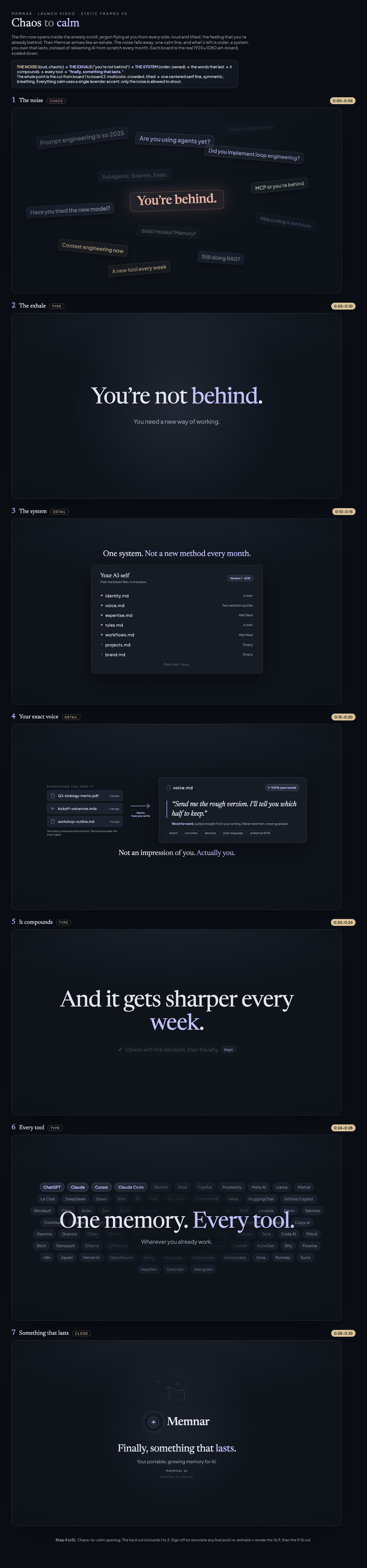
The arc I landed on is ‘chaos to calm’. It opens on the noise, a scatter of half-read messages and a quiet ‘You're behind’, then everything clears to a single line: ‘You're not behind.’ From there it builds, one calm frame at a time, to ‘One memory. Every tool.’ and the Memnar lockup.
The result
Watch the video in the Substack edition
The process
Here's the process and the parts I find genuinely useful. Before anything moves, I render every scene as a still and review them stacked in a little local editor called Lavish, where I can annotate a frame and approve it or send it back. The cheapest place to catch a video going wrong is the static frame, not the finished render. It is kind of slow, but it saves me a full re-render every time I change my mind, and it keeps me honest about whether each scene earns its place.
What I read this week
In the Weights: Annet Kloprogge. The site asks a row of LLMs to write my biography, and almost none of them get it right. The one correct version sits at the very bottom, flagged as a hallucination. That gap, between what's true about me and what the models believe, is the whole reason I'm building Memnar.
5 steps to create amazing videos by Peter Yang. The method behind the calm launch video I started this week, one idea per scene, type over UI.
Stop the Token Bleed: Cost Control for Claude Code. A practical guide to what your agents actually cost.
AI made writing code cheap, the new bottleneck. The argument that once code is cheap to write, reviewing and deciding becomes the real constraint.
Stanford STORM. An open-source system that researches a topic from many angles and drafts a long article, a peek at where AI-assisted writing is heading.
I spent this week naming a thing and then making it safer instead of bigger. Ask me again in a month whether that was the right order.
If you're building something solo with AI in the loop, hit reply and tell me what you're renaming, breaking, or hardening right now. I read everything.