
Ten minutes into a prep meeting last week, a colleague asked me what one of the terms in my own Excel meant. I couldn’t answer her.
We were building a session for a client, and the Excel was ready before the meeting started. Claude Code had generated it with agents, columns and terms included. I never really felt ownership over it.
I asked for more time before I answered her. I was embarrassed.
Over the next few days I cut, and cut, and cut. Before cutting, it took a minute to generate that file, but none of it was really ‘mine’ yet. Making it mine, I now refer to as ‘sculpting’: the whole thing is already there, and I take material away.
A file like that used to take me two days from a blank page. Now it takes two hours. I’m not going back to the two days, so I correct what comes out, and I write the correction down.
Every slide in that deck had too much text. The Excel kept its tabs and its columns, and the cells went from eight lines of text to four.
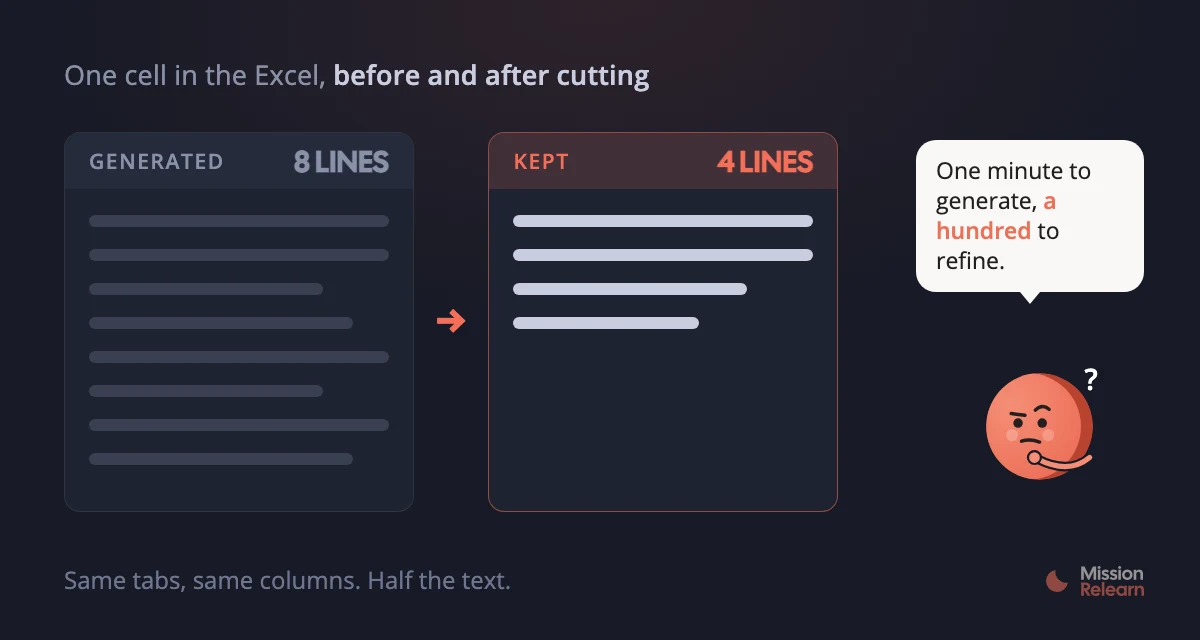
If it takes one minute to generate, it should take a hundred to refine. Sometimes I hit the hundredth minute and the one minute of generating wasn’t worth it. I write down why, in the file my system reads before it writes, so the next generation starts with that note. The hundred minutes do come down. I go through a review in fifteen minutes now.
This week I cut a second file, a slide deck, ten slides, for a talk I’m giving on Thursday (still cutting). I’d read it, change three lines, leave it, and come back the next morning knowing which slide was wrong. A first version rarely reads like me.
The file that logs all these mistakes is my pattern log. It holds the corrections, so the next draft arrives without them (most of the time). It has grown to 829 patterns across 73 sections, 58 marked as ‘high’ (pattern confidence).
The file is 13,636 lines, too big to load into a session, so a script generates an index next to it. AI searches the index for a word from the title, then opens forty lines around the hit.
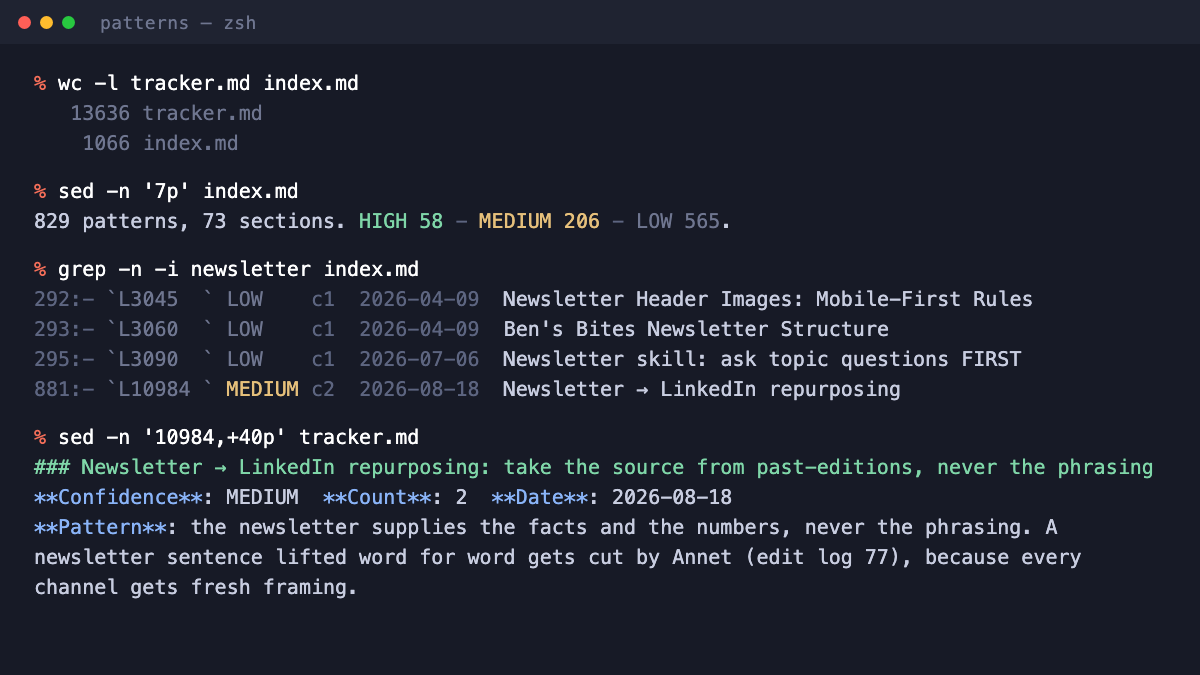
One of those sections is 47 numbered notes about how I write. Number 44 says it adds a sentence after a row of numbers explaining what the numbers mean.
Every time you correct a generation, let AI write one line in your pattern log: what you took out, and why. Anything that shows up twice goes into the pattern log.
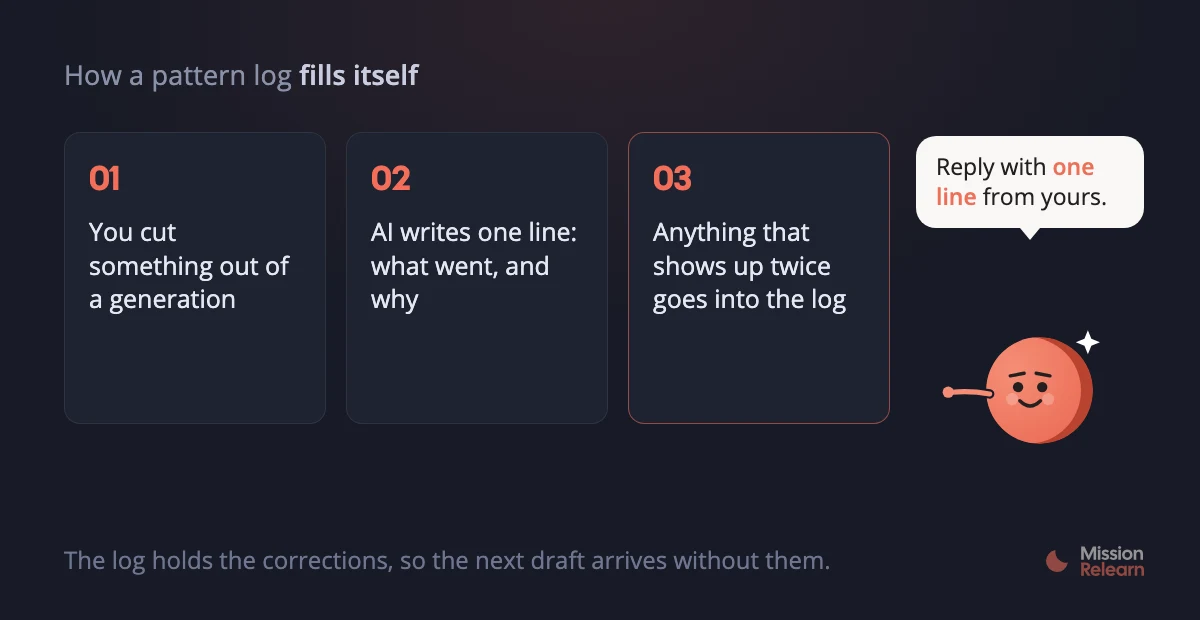
Do you keep something like this? Reply with one line from yours. If you don’t keep one, tell me the correction you find yourself making over and over. That’s your first line.
What I read this week
qm, Y Combinator. They open-sourced their own agent harness: every employee gets an isolated workspace, the team shares skills, and it runs from Slack.
60-plus unconventional growth tactics, Tom Orbach. Every tactic comes with an execution recipe, a real proof point and a cost estimate, and almost none of them involve buying ads.
Meet Ava, the WhatsApp agent, The Neural Maze. The whole build written out: LangGraph as the brain, SQLite for short-term memory and Qdrant for long-term, Groq for text and speech, FLUX.1 for images, ElevenLabs for the voice.
ManyChat. The no-code route to the same thing, for when you want the WhatsApp or Instagram agent and not the build.
Probability for Artificial Intelligence, Stanford. Chris Piech's free course on the maths underneath AI, written for humanists and social scientists as much as for engineers.
I found the first vibecoded business that makes real money, YouTube. One person's search for a vibecoded product with actual revenue behind it.