Back in April I wrote version 1.0 of my personal AI policy: nine short sections, with a date on the bottom (it's definitely due for version 1.1).
For new readers: I run Mission Relearn, an AI-literacy consultancy, and I build Memnar. If I tell a client to be open about AI, I have to be open about AI myself. Since April, my rules are on paper, and I can show them when a client asks.
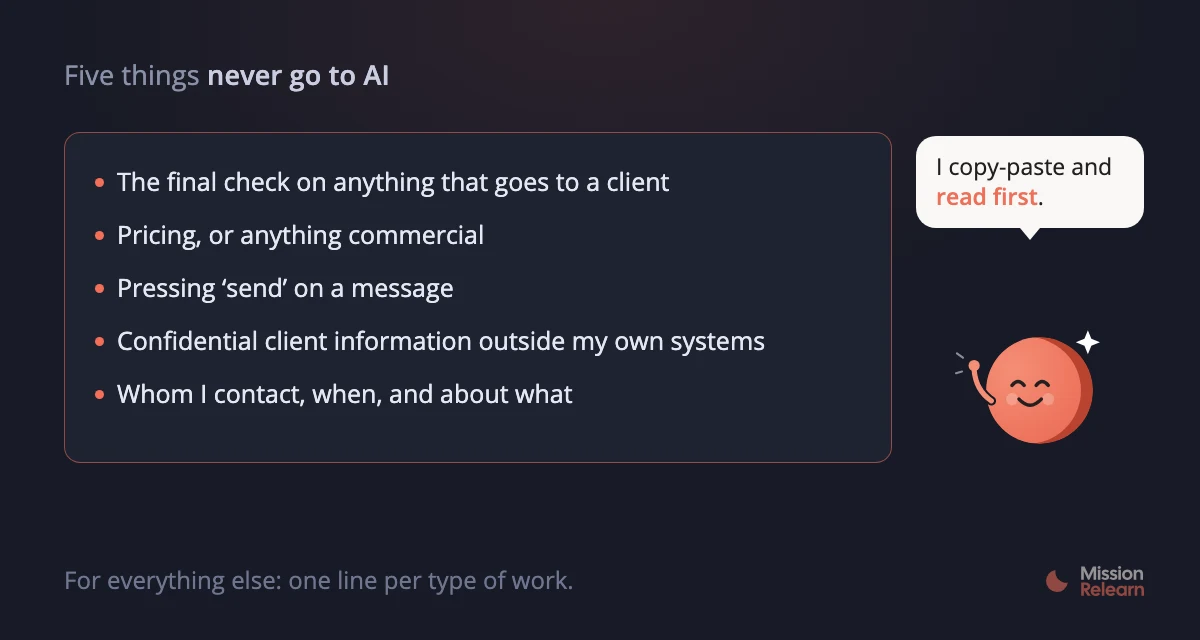
The section I use most is the shortest one. Five things never go to AI. The final check on anything that goes to a client. Pricing or anything commercial. Pressing 'send' on a message (I copy-paste and read first). Confidential client information outside my own systems. And whom I contact, when, and about what.
For everything else, I keep one line per type of work (proposals, training content, meeting follow-ups, code, research): what AI does, what stays human. For a proposal, AI drafts the structure and the first text, and I do the alterations, final pricing, and everything that depends on knowing the person who will read it. When I'm finally hitting 'send', AI learns from the edits I have made.
The data rules are two lists. What goes in: my own drafts and ideas, public information about clients and prospects, transcripts of my own meetings, and any task or context that matters.
What stays out: client credentials and API keys, signed NDAs, personal data beyond what someone shared with me in a professional context, and client financials shared in confidence. And of course where the work happens: Claude Code runs on my laptop and Mac Mini, and client documents stay in Nextcloud, my self-hosted cloud environment.
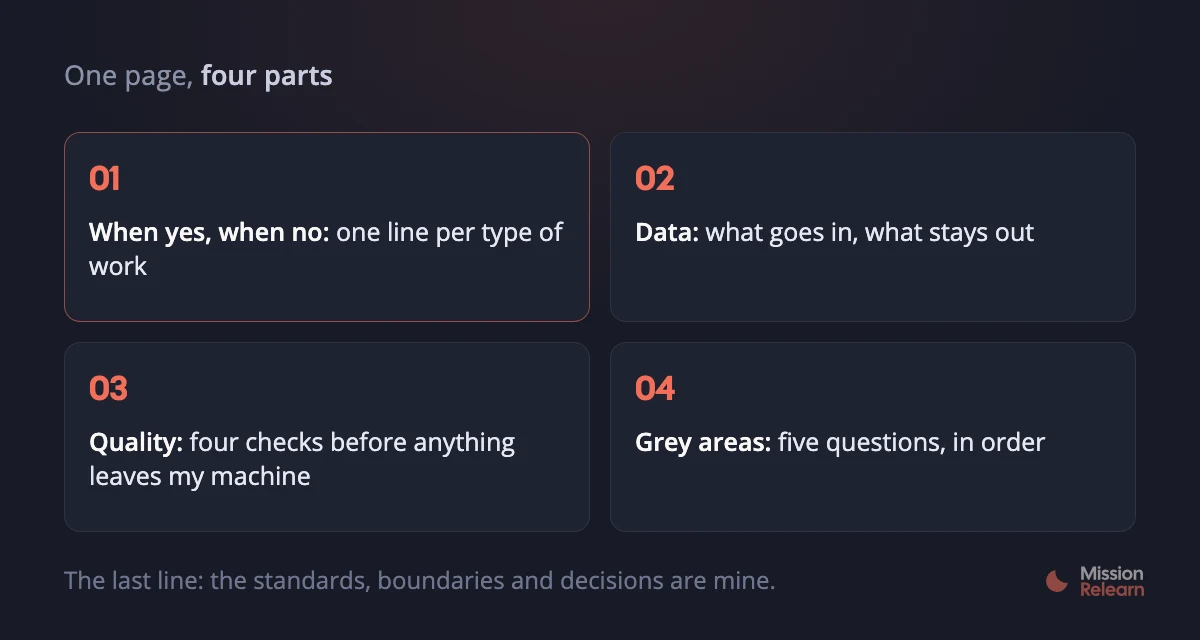
Then quality. Before anything AI-assisted leaves my machine, it gets four checks: facts against the source, does it sound like me (voice.md), does it cover what the client asked for, and could it mislead or disadvantage anyone. On top of that, each type of output has its own extra check: a proposal I sometimes print out, a LinkedIn post gets the question of whether I would say this at a conference, and for research I check every source, because AI can make up URLs and publication dates.
For the grey areas that survive all of that, the policy has five questions, in order. The first one settles most cases: would I be comfortable if the client saw exactly how I made this? If the answer is no, I change the process. The last one: what would I advise a client to do here?
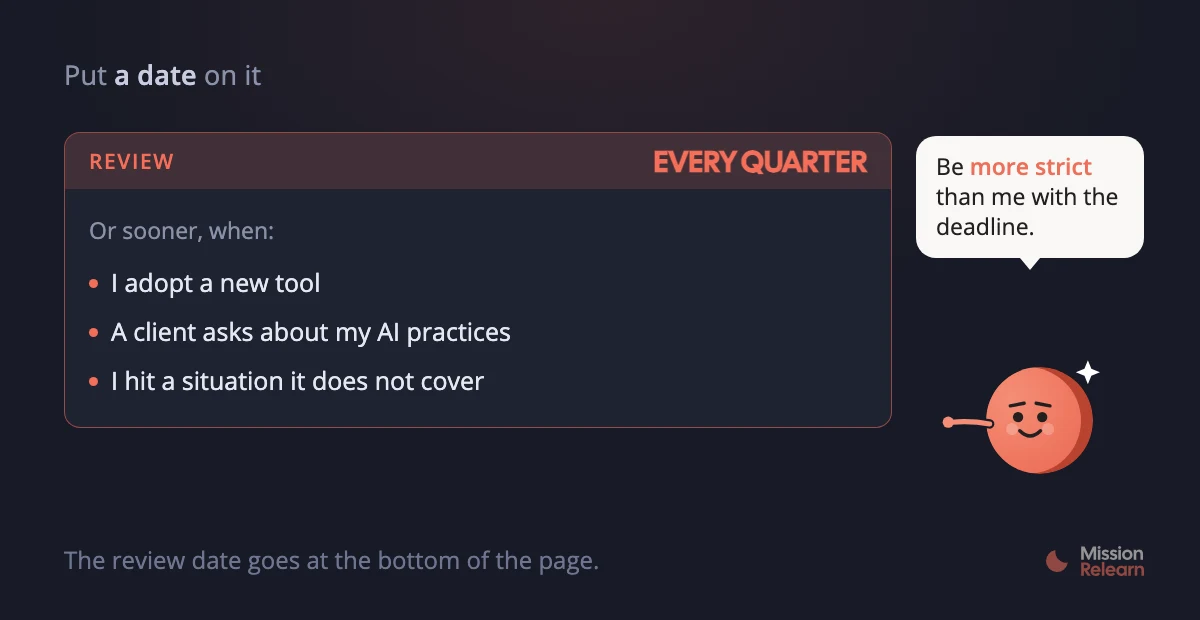
The document ends with a review schedule: every quarter, or sooner when I adopt a new tool, a client asks about my AI practices, or I hit a situation it does not cover or honour. The last line says AI was the thinking partner and the standards, boundaries and decisions are mine.
Write yours this week
Today I put the lesson 'Write your own AI policy' online for free, no account needed. It is the second lesson of the last module of 'AI Fundamentals Basics', and it also works fine on its own. Plan 30 minutes and have your AI chat open.
The lesson gives you one page with four parts. When yes, when no: which kinds of tasks you do with AI and which you keep for yourself, plus the list of things you never hand to AI, written out.
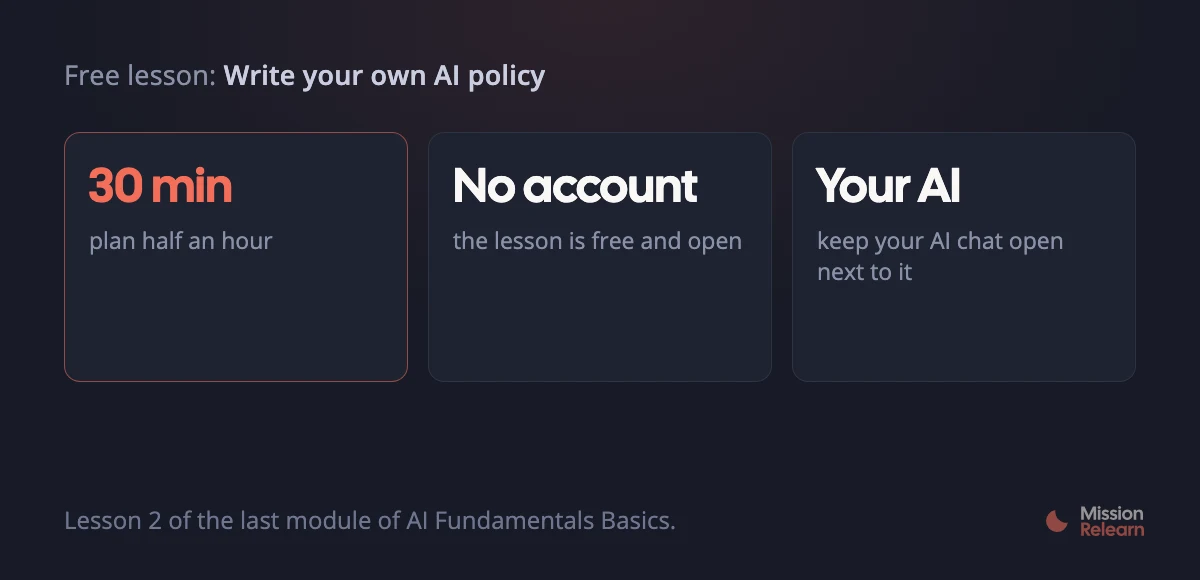
Write it together with your AI. When the page is done, put a review date at the bottom. And be more strict than me with the deadline (haha).
What I read this week
Honey (I Shrunk the AI): a skill for Claude Code, Cursor and Codex that makes the agent write less code and less prose, with a benchmark of 53% fewer lines and every unit test still passing.
Coding Wrapped: turns your local Claude Code and Codex history into a pixel-art story of how you work with AI, and it stays on your own machine.
Has AI already killed sales training?: Rhys Fisher built a free Claude plugin in 48 hours that audits every sales call against MEDDPICC and coaches each rep every morning, and asks what is left of a six-figure training programme.
HuggingChat: free chat over 139 open-source models, with a router that picks the model per request.
Agentic Integrity Foundation: a free local tool that checks a coding agent's tool calls before they run, which is the ‘with which data’ part of your policy, enforced.
Fireworks AI: model hosting that claims to cut AI coding spend by 50 to 75% by routing each request to the cheapest model that can do the job.
If you already have a policy, reply with the rule that was hardest to write down. If you do not have one yet, reply with the rule you know will be hard to keep. Curious to hear more!